

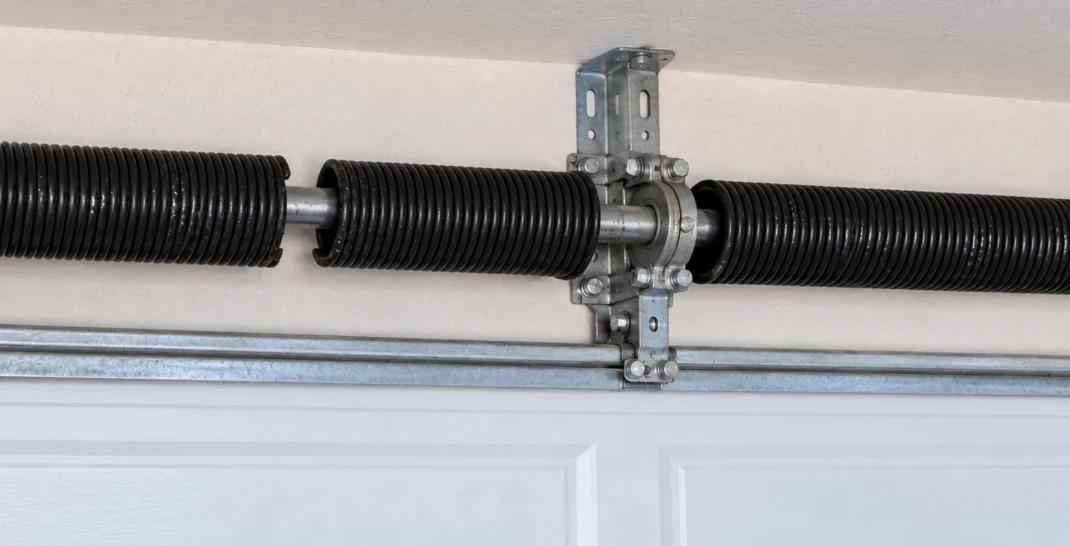
A loud bang followed by a garage door that will not open can indicate a broken garage door spring. A visible separation in an exposed torsion spring is an important clue, but sound alone cannot identify the failed part. Stop using the door and arrange an inspection rather than repeatedly pressing the opener or trying to lift it yourself.
It can happen when nobody is near the controls. You hear a sharp crack from the garage, look around for something that fell and find nothing obvious. Later, the door refuses to lift or starts moving and stops almost immediately.
If your car is inside, the practical questions come quickly. Can you pull the red release cord? Does the opener need replacing? Should a spring replacement include one spring or two?
Here is what those symptoms can mean, what to tell a repair company and how to assess the proposed work.
What to Do Immediately After the Bang
- Stop operating the door. Do not keep trying the remote, wall button or app to see whether another attempt works.
- Keep the opening clear. Keep people and pets away from the door, particularly if it is partly open, crooked or visibly damaged.
- Leave the release cord and hardware alone. A suspected spring failure changes the situation from a routine power outage. Do not disconnect or attempt to move an unsupported door.
- Call a garage door technician. Explain whether the door is closed, partly open or fully open, and whether a vehicle is trapped inside.
You can take a photo from a safe position if the components are visible. There is no need to climb, reach toward the springs or move the door to make the picture clearer.
Why a Broken Garage Door Spring Makes a Loud Noise
Garage door springs store energy to help counterbalance the door. That support allows a correctly matched door and opener system to move without the motor having to lift the unsupported weight of the door.
When a spring fractures, the sudden release of energy can produce a sharp bang. The sound may be startling even when the door itself has not visibly moved.
A spring can break while the door is closed, so a noise from an apparently empty garage does not rule out spring failure. You also do not need to find a loose piece on the floor. A conventional torsion spring sits around a shaft, where a break can leave separated sections still in place.
Other mechanical problems can also cause a bang. The timing of the sound, visible condition and any change in operation help guide an inspection. None of those observations replaces checking the actual system.
Signs of a Broken Spring and Other Problems
Use the table below to describe what you have already noticed. Do not operate the door again to reproduce a symptom.
| What You Have Noticed | What It May Indicate | What to Tell the Technician |
|---|---|---|
| A distinct gap within an exposed spring coil | A broken torsion spring | Where the gap is and whether there are other visible springs |
| The door rose a few inches and stopped | Missing spring support, resistance or another door or opener fault | How far it moved before stopping |
| The motor made a sound but the door stayed down | The opener may be responding without being able to move the door | Whether there was humming, clicking or movement in the opener rail |
| The door sits crooked or a lifting cable hangs loose | A cable, spring or related mechanical problem | Which side looks different, without touching it |
| There is no obvious spring break | The fault may be elsewhere or within a concealed spring system | What you can see and the door’s current position |
An opener light coming on does not establish that the opener is healthy. Equally, a door failing to lift does not establish that the motor has failed. The door and opener need to be considered together.
Why You Might Not See a Gap in the Spring
Spring systems are not all arranged the same way.
Exposed torsion springs are commonly fitted around a shaft above the opening. A fracture may create a noticeable separation in a coil.
Extension springs run alongside the upper tracks on some doors. Their layout differs from a torsion system, so an online photograph of a broken torsion spring may not resemble your equipment.
Enclosed spring systems keep the spring inside a tube. On these doors, a break may not be visible from the outside. Certain Wayne Dalton systems are one example of this design.
The absence of a visible gap is therefore not a reason to keep testing a malfunctioning door. Do not remove a cover or open a spring tube to investigate. A technician can identify the system and inspect it using the appropriate procedure.
Can You Open the Door Manually If the Spring Is Broken?
Do not try to operate a door with a broken spring, either manually or with the opener.
The red emergency release disconnects the opener from the door on many systems. It does not replace the support lost when a spring fails. If the door is raised, disconnecting it when the spring system is compromised can allow unexpected movement.
Instructions for opening a properly balanced door during a power outage should not be applied to a door that may have a broken spring, loose cable or other mechanical damage.
If your car is trapped, tell the repair company at the start of the call. Ask about the earliest available visit and explain whether you have another entrance to the garage. Arrange another way to travel while the door is assessed.
Do not ask someone to help the opener lift the door, crawl underneath a partly open door or assume a temporary prop makes the opening safe. Getting the vehicle out should be part of a controlled service assessment.
What If the Door Still Opens After the Bang?
Movement does not prove that the system is safe. A door with more than one spring may still move after one spring fails. That does not mean the remaining spring and opener are an acceptable substitute for the failed part.
If you have heard an unexplained bang and then noticed rough movement, hesitation, a new gap in a spring or another visible change, stop using the door and report it. Avoid another opening cycle simply to check whether it still works.
Be clear about the sequence. “It made a bang while closed and lifted only a few inches afterward” tells a technician more than “the opener is broken.”
Does a Broken Spring Mean You Need a New Opener?
No. The spring system and opener have different jobs. A broken spring needs attention even if the opener responds to the remote.
A stronger motor is not the remedy for an improperly balanced door. Increasing opener force to push through resistance can also overlook the mechanical fault that needs repair.
The useful first question is whether the door has the support and freedom of movement it should have. The technician can then assess whether the opener also suffered damage or has a separate fault.
If opener replacement is proposed, ask:
- What has failed in the opener itself?
- What evidence supports that diagnosis?
- Is a compatible repair available?
- Why is replacement preferable for this equipment?
The explanation should address your opener’s condition. “The door will not open” describes a symptom, not a complete reason to replace the motor unit.
Should You Replace One Spring or Both?
For a door with two springs, replacing both when one breaks is established industry guidance. This is particularly relevant when both were installed together and have experienced similar use.
Replacing the pair can avoid leaving another worn spring in service and gives the technician an opportunity to establish the correct spring arrangement for the door.
However, not every door has two springs, and repair histories differ. If one spring was replaced recently, provide the invoice or details and ask how that affects the recommendation. The decision should follow the door manufacturer’s requirements and an assessment of the installed system.
Useful questions include:
- How many springs does this door use?
- Are the existing springs the correct specification?
- Does the estimate include the complete required spring set?
- What condition is the remaining spring in?
No inspection can reliably promise the exact day another spring will fail. A recommendation to replace an aging pair should explain the practical reason without inventing a countdown.
How the Technician Chooses a Replacement Spring
Garage door springs are not universal parts. Correct selection depends on the door and its counterbalance system, including factors such as weight, height and track arrangement.
The appropriate replacement may therefore differ from a spring that merely looks similar. Previous modifications to a door can also matter when checking whether the existing setup is suitable.
You do not need to measure a broken spring, weigh the door or identify the winding direction yourself. Ask the technician to explain how the proposed parts suit your equipment.
If an upgrade is offered, ask what changes and why. A clear explanation should identify the specification or benefit rather than relying on a label such as “premium.”
What a Spring Cycle Rating Means
A complete opening and closing sequence counts as one cycle. A household that uses the garage for several departures and returns each day can accumulate cycles faster than one that rarely uses the door.
Where compatible options are available, a spring with a higher cycle rating may be worth discussing. Ask for the actual rating and the warranty terms separately. A cycle rating is not a guarantee that a spring will last a particular number of years.
Can Florida Humidity Affect Garage Door Springs?
Corrosion is worth considering in a humid or coastal environment. Rust can reduce spring wire strength, and corrosion pits can contribute to fatigue cracking. That makes visible deterioration relevant to an inspection in Boca Raton or West Palm Beach.
It does not mean every broken spring was caused by salt air or Florida weather. Use, installation, spring selection and other conditions can also affect service life.
After the repair, ask for maintenance instructions suitable for the installed equipment and its environment. Do not assume every moving component needs the same lubricant or that extra spray can make a damaged spring safe.
Lubrication cannot join a fractured spring back together. A broken spring requires an appropriate replacement and checks of the system it supports.
Does a Broken Spring Mean You Need a New Garage Door?
A spring failure alone is not enough to justify replacing the entire door. The condition of the panels, tracks, attachments and other components matters.
If the door is otherwise suitable for continued use, spring replacement may address the failed component. If there is additional damage, the repair proposal should identify it separately.
For example, if the top section has bent or the opener attachment has pulled away, ask whether the damage can be repaired appropriately and what supports a recommendation for replacement.
Request a clear distinction between:
- Work needed to address the spring failure.
- Work needed for other observed damage or wear.
- Optional upgrades you can consider separately.
A loud bang should lead to an inspection of the equipment you have. It should not, by itself, decide whether you buy a new door.
What a Spring Replacement Estimate Should Include
An estimate is easier to assess when it identifies the actual work. Ask which springs are included, what labor covers and whether other components need replacement.
The total can depend on the spring system, compatible parts, associated damage, access and the scope of the visit. A price mentioned in a discussion forum may concern a different door, location or level of service.
Before approving work, clarify:
- Whether a service or diagnostic charge applies.
- The number and specification of the replacement springs.
- Which additional repairs are required and why.
- Whether labor and any removal or disposal charges are included.
- Whether optional upgrades are listed separately.
- What approval is needed before additional work begins.
- What parts and labor warranty terms apply, if any.
Ask about appointment availability and expected work separately. A simple spring replacement and a door with damaged hardware may require different arrangements, so an arrival or completion time should be confirmed for your situation.
What to Check Before Using the Door Again
The repair should be assessed as a working system. A technician should check the door’s balance and movement, inspect relevant lifting components and verify opener operation and safety functions using the manufacturer’s procedures.
Ask the technician to demonstrate normal operation after the work is complete and explain any remaining concern. If the door still hesitates, travels unevenly or makes an unexplained bang, raise it before returning to regular use.
Keep the invoice and any part specifications or warranty information provided. Those details help if you need to discuss the repair later.
Frequently Asked Questions
1. Can a Garage Door Spring Break When the Door Is Closed?
Yes. The spring system remains loaded when the door is closed, so failure does not require someone to press the opener. A bang while the garage is quiet can be consistent with a broken spring. The cause still needs checking, especially if there is no visible fracture or the sound might have come from something else.
2. My Garage Door Opens a Few Inches and Stops. Is the Spring Broken?
A broken spring is one possibility, particularly after a bang. Other mechanical or opener faults can also interrupt opening. Report the movement you have already observed and any visible spring gap, crooked panel or loose cable. Do not keep operating the door to test which component is responsible.
3. Can a Spring Be Broken If the Opener Light Still Comes On?
Yes. The opener can receive a command or illuminate its light even when the door has lost spring support. The light does not confirm that the door is balanced, and it does not rule out an additional opener problem. Both systems should be considered during the assessment.
4. Can I Use the Door for a Few Days If Only One Spring Has Broken?
Do not continue using a door with a broken spring. The fact that another spring or the opener can still move it does not establish safe operation. Arrange service and explain whether the door is closed or raised so the technician understands the immediate situation.
5. Can I Pull the Emergency Release to Get My Car Out?
Do not use the release as a workaround for a suspected spring failure. Disconnecting the opener does not restore the spring support, and a raised door may move unexpectedly. Tell the repair company that a vehicle is trapped and ask about the earliest available assessment. Power outage instructions assume a different situation from a mechanically damaged door.
6. Why Is There No Visible Gap If I Heard a Spring Break?
Some systems contain the spring inside a tube, so you may not see the broken coil. It is also possible that another component caused the sound. Do not dismantle the spring system or operate the door to settle the question. A photo of the visible arrangement can help the technician prepare for the visit.
7. Can Lubricant or a Spring Adjustment Fix a Broken Spring?
Lubricant cannot repair a fracture. A confirmed broken spring requires replacement with suitable parts. If the spring is not broken, another balance or mechanical issue may need attention, but that determination belongs in the inspection. Do not attempt to restore movement by tightening spring hardware or increasing opener force.
8. How Quickly Can a Broken Garage Door Spring Be Replaced?
Timing depends on appointment availability, the installed system, access, suitable parts and any additional damage. Explain the symptoms when booking and ask whether the likely parts can be confirmed beforehand. Avoid assuming that another homeowner’s repair time guarantees the same result for your door.
Garage Door Spring Replacement in Boca Raton and West Palm Beach
Call Rapid Garage Repair with your city or ZIP code, the door’s current position and what happened before it stopped opening. Mention any visible spring gap, loose cable or trapped vehicle at the start of the call.
Confirm service coverage and the earliest available appointment when you call. You do not need to identify or remove the failed part before asking for help.
Call Now