


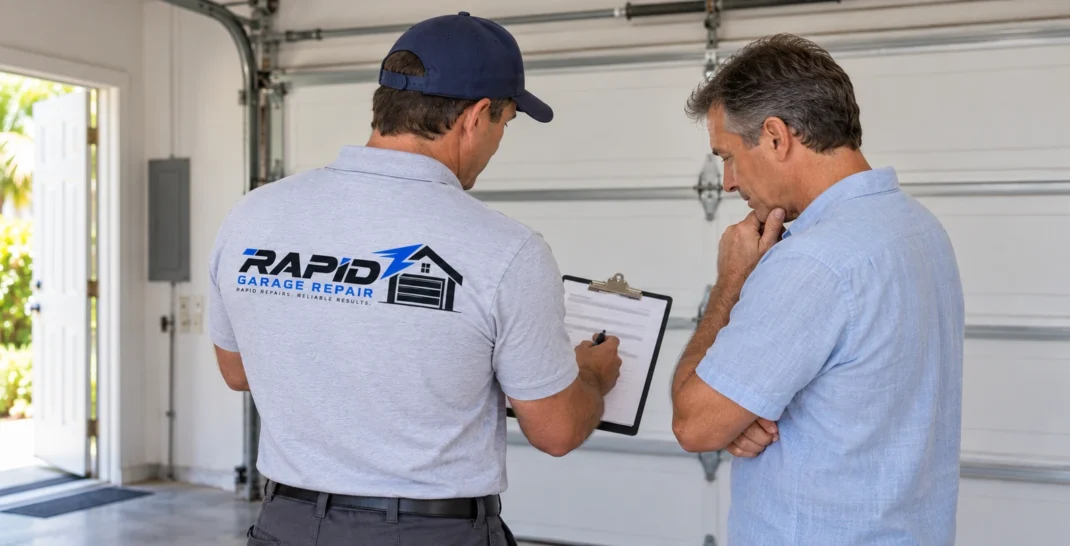
Compare garage door repair quotes by checking the diagnosed problem, replacement parts, quantities, labor, additional charges and warranty terms. The total becomes meaningful once you understand what each company has included and why the work is needed.
You might call about one broken spring and receive a proposal for springs, rollers, bearings, cables and a new opener. Another company may recommend a much smaller repair. That leaves an understandable question: has the first inspection found more damage, or are you being offered work you do not need?
The answer should come from the condition of your door and a clear explanation of the proposed repair. Here is how to compare estimates, question unfamiliar items and make a decision without needing to become a garage door technician yourself.
Give Each Company the Same Information
Describe what the door is doing before suggesting a replacement part. “The motor hums, but the door stays closed” is more useful than assuming the motor needs replacing.
When requesting a garage door repair estimate, share:
- Your city or ZIP code.
- Whether the door is closed, partly open or fully open.
- The symptom, such as reversing, stopping during travel or failing to respond.
- Any recent bang, impact or visible damage.
- The door and opener model, if you can identify them safely.
- Any recent repairs and available invoices.
- Whether a vehicle is trapped or the garage cannot be secured.
Photos taken from a safe position can help a company understand the setup. Do not climb, remove covers or operate a damaged door to provide more information.
If a spring is broken, a cable is loose or the door is crooked, keep it out of use while arranging service. Tell the company about the immediate condition so it can discuss the appropriate next step.
Understand Phone Estimates and Diagnostic Charges
A phone conversation can clarify the likely type of visit, appointment availability and possible charges. It may not establish which components have failed or the final repair scope.
A company may need to inspect the door before identifying suitable parts. That is different from leaving you unsure what the inspection itself will cost.
Before booking, ask whether there is a visit or diagnostic charge, what it includes and what you would pay if you decline the repair. If the charge can be credited toward approved work, ask how that credit is applied.
Also clarify the appointment’s purpose. An estimate request, a paid diagnostic visit and authorization to begin repairs are different arrangements. If diagnosis requires disassembly or other paid work, agree on that scope and charge first.
Keep any written booking confirmation. It helps everyone refer back to what was arranged.
What a Written Repair Estimate Should Include
A useful estimate connects each proposed item to the problem being addressed. It also makes the total and any conditions clear enough to compare with another proposal.
| Item to Check | What You Want Clarified |
|---|---|
| Diagnosis | What failed or what condition needs correction |
| Replacement parts | The component, quantity and relevant specification or model |
| Labor | Which repair, installation and adjustment tasks are included |
| Operational checks | How the completed work and relevant safety functions will be verified |
| Visit and other charges | Diagnostic, travel, urgent attendance, removal or other applicable fees |
| Total | The amount for the selected work and whether applicable taxes are included |
| Additional work | What requires further approval and how the price would be confirmed |
| Warranty | Covered parts, labor, duration, exclusions and claim arrangements |
| Timing | Expected scheduling, parts availability and any completion conditions |
Ask for plain descriptions where a package name is unclear. “Complete rebuild” or “premium repair” does not tell you which parts are included.
A package can still be clearly priced without listing every small fastener separately. What matters is being able to identify the work, understand the exclusions and see the total you are approving.
Compare the Same Repair Before Comparing Prices
Imagine two estimates for a door with a broken spring.
Estimate A includes the required spring replacement, labor, balance assessment and operational checks.
Estimate B includes those tasks plus new rollers and a new opener.
The larger total does not tell you whether the added work is justified. First ask which findings support the rollers and opener replacement, and whether they are required repairs or optional recommendations.
Then ask both companies to identify the cost of addressing the confirmed fault, with additional work listed separately. If their diagnoses differ, ask them to explain the difference.
This also works in the other direction. A smaller estimate may leave out a necessary repair, a visit charge or a suitable part specification. You need those details before treating it as better value.
Why Garage Door Repair Costs Differ
Two quotes may involve different work even when both are described as “fixing the garage door.” Differences can include the installed spring system, number of components, door size, compatible parts, access, associated damage and service arrangements.
Warranty coverage and included follow-up can also differ. One proposal may include labor coverage that another excludes. A quoted visit charge may be included in one total and added separately to another.
Online prices introduce another comparison problem. A retail listing for a part does not include a technician’s visit, diagnosis, installation, adjustments and checks. It also may not identify the correct component for your door.
A substantial difference deserves an explanation. Ask what you receive for the difference rather than assuming that a higher price proves quality or a lower one proves a problem.
Are Extra Bearings, Cables and Rollers Necessary?
They can be. A spring failure does not prevent other components from being worn or damaged. Equally, the presence of one failed spring does not explain every item in a large repair package.
Ask the technician to identify the condition behind each recommendation. Frayed lifting cables, damaged rollers or deformed hardware raise different concerns from a component being offered as a convenience upgrade.
You can ask to see a photograph or have the finding explained from a safe position. Do not touch tensioned components or attempt to recreate the inspection.
For each added item, establish whether it is:
- Necessary to complete the identified repair correctly. The proposal should explain the connection.
- Recommended because of an observed condition. Ask about the condition and the consequence of postponing attention.
- An optional improvement. Ask what benefit it provides and how it changes the total.
For cable drums, bearings or other less familiar parts, request the specific reason for replacement. If the explanation is simply that everything must always be changed together, ask which manufacturer requirement or inspection finding applies to your system.
A sensible inspection may uncover several genuine needs. Clear evidence helps you distinguish that situation from an unexplained list of replacements.
What to Check in a Spring Replacement Quote
Confirm the Number of Springs
Doors use different spring arrangements. For a system with two springs, replacing both when one breaks is established industry guidance, particularly when they have the same service history.
An estimate for one spring and an estimate for a pair therefore need clarification before comparison. Give the technician any records showing that a spring was replaced recently and ask how the existing arrangement affects the recommendation.
Check Spring Compatibility
Springs must suit the door’s counterbalance requirements. “Heavy duty” is not enough information to establish compatibility.
Ask the company to identify the proposed spring specification and explain its suitability. You do not need to measure or remove a spring yourself.
Compare Cycle Ratings and Warranties
If a higher-cycle spring is offered, ask for the rating and the terms of the upgrade. A cycle describes an opening and closing sequence; it does not represent a fixed number of days or years.
Usage, installation and conditions affect spring life. A warranty described in years and a spring described by cycle rating answer different questions. Compare both rather than treating one as proof of the other.
How to Compare Opener Repair and Replacement Quotes
If a quote includes a new opener, ask what fault has been found in the existing unit. A door that fails to move may have a mechanical problem, an opener problem or both.
An improperly balanced door needs attention to its counterbalance system. Installing a more powerful opener is not the remedy for that condition.
Ask why repair is or is not suitable for the particular opener. The explanation might involve a failed component, compatible parts availability or the equipment’s ability to provide safe operation. An age estimate alone gives you less information than a specific assessment.
When comparing replacement proposals, check the exact model and what installation includes. Relevant details can include:
- The rail and any extension needed for the door height.
- Compatible controls, remotes and safety sensors.
- Mounting hardware and any required door reinforcement.
- Setup and testing of the installed system.
- Removal of the old equipment.
- Parts and installation labor coverage.
Features such as battery backup, a camera or connected controls can explain part of a price difference. Decide which features matter to you after confirming the equipment is suitable for the door.
Panel Repair vs. Full Door Replacement
Damage limited to a section does not automatically require replacing the entire door. A suitable replacement section may be an option, depending on availability, compatibility and the condition of the remaining system.
Ask whether the proposed section is the correct match for the door, whether its appearance will differ and whether other damage affects the repair. A similar color and width do not establish that sections are interchangeable.
If complete replacement is recommended, ask why section repair is unsuitable. The explanation should address the actual damage, available components and overall condition.
Compare complete proposals. A new door package that includes tracks, hardware and installation cannot be fairly compared with the supply price of a bare door. Ask what will be replaced, what is proposed for reuse and how compatibility is established.
Replacement Door Requirements in Boca Raton and West Palm Beach
When a repair discussion becomes a door replacement proposal, clarify the product and installation requirements for your address.
Ask for the exact manufacturer and model, the relevant product approval documentation, and confirmation of the required wind pressure and impact performance where applicable. Wind pressure resistance and impact resistance describe different forms of protection.
The phrase “hurricane rated” does not give you all those details. Ask how the selected door and installation meet the requirements for the opening.
Also establish who will handle any required permits, supporting documents and inspections, and whether associated charges are included. Confirm requirements with the building department responsible for the property. City and unincorporated county processes are not interchangeable.
These are questions about a replacement project. Do not assume that every minor garage door repair has the same permitting requirements.
Read the Warranty Beyond Its Headline
A warranty may cover a particular component while excluding labor to remove or reinstall it. Coverage for an opener also does not necessarily cover the door, springs or other hardware.
Before comparing two warranty offers, ask:
- Who provides the coverage?
- Which parts and types of failure are covered?
- Is labor included, and for how long?
- Is a diagnostic, travel or service charge payable on a claim?
- Are maintenance visits or a paid service plan required?
- What exclusions apply?
- Does coverage transfer if the property is sold?
- How do you arrange service and document a claim?
If an offer uses the word “lifetime,” ask whose or what lifetime it refers to and request the written terms. Compare the protection you can actually use, including any future charges, rather than the length of the headline alone.
Keep manufacturer product coverage and the installer’s workmanship coverage distinct when discussing the proposal. They may be provided by different parties and have different conditions.
When a Second Opinion Is Worthwhile
Another inspection can be useful when companies disagree about the fault, an initially limited repair becomes a major replacement, or you cannot get a clear explanation for the proposed work.
For planned work, compare several written estimates when practical. For an urgent problem, first discuss what is necessary to leave the door safely secured and what that work would cost. Keep any initial authorization clear if you still want to compare the larger repair proposal.
Keep a damaged door out of use while arranging another assessment. Do not pull the emergency release or force movement to test competing diagnoses.
When reviewing the companies themselves, confirm who will perform the work, whose name will appear on the invoice and who will handle follow-up. Check any claimed credentials and the requirements for the actual work with the relevant authority. Reviews can inform your decision, but the written scope and explanation still matter.
Questions to Ask Before Approving the Repair
You can keep the conversation simple:
Please show me what has failed, explain the work needed to correct it and list any optional recommendations separately. What is the total for the work I am approving, what could change it, and what parts and labor coverage will I receive?
Read the estimate before signing. If the selected scope changes, request an updated description and total before approving the additional work.
After the repair, ask the technician to demonstrate operation and explain the checks performed. Compare the final invoice with the work you authorized, clarify any difference and keep the invoice, specifications and warranty documents together.
Frequently Asked Questions
1. How Do I Know Whether a Garage Door Repair Quote Is Reasonable?
Start with a written diagnosis and scope, then compare proposals covering the same work. Check part quantities, relevant specifications, labor, visit charges and warranty coverage. A total from another homeowner’s discussion post may concern a different door, location or service arrangement. If local estimates differ substantially, ask each company to explain the difference in work or terms.
2. Should I Always Choose the Cheapest Garage Door Repair Estimate?
Check what the price includes before choosing. A smaller total may cover fewer parts, exclude a visit charge or provide different labor coverage. A higher total also needs justification. The useful choice is a suitable repair with a clear scope and terms you understand, supported by the inspection findings.
3. Can a Company Charge for an Estimate or Diagnostic Visit?
Some companies charge for attendance or diagnosis, while others offer particular estimates without a fee. Ask about the arrangement before booking rather than assuming either policy. Confirm what the visit includes, what you pay if you decline the repair and whether any charge is credited toward approved work. Keep the confirmation with the estimate.
4. Why Did the Price Change After the Technician Inspected the Door?
An inspection may identify a different fault, a different spring arrangement or additional damage that was not clear over the phone. Ask which finding changed the proposed work and request the revised scope and total. If a figure was presented as a firm price for the same work, ask the company to explain why it is changing. Clarify the difference before authorizing repairs.
5. Is Replacing Both Garage Door Springs an Unnecessary Extra?
For a door with two springs, replacing both after one breaks is established industry guidance, especially when they have experienced similar use. It should still be clear how many springs your door uses and what the estimate includes. Share recent repair records so the technician can consider the actual system and service history.
6. Must Every Bearing, Cable and Drum Be Replaced With a Broken Spring?
A broken spring alone does not explain the condition of all the other components. Additional parts may need replacement because of wear, damage or compatibility requirements. Ask the technician to identify the reason for each item and separate required repairs from optional improvements. Avoid handling the components yourself to verify the recommendation.
7. Does a Lifetime Warranty Mean Future Repairs Will Be Free?
Only the written terms can tell you what is covered. Parts, labor and attendance charges may be treated differently, and coverage can have conditions or exclusions. Ask about future service costs, maintenance obligations, ownership restrictions and who provides the warranty. A long coverage period does not, by itself, establish that every future bill will be covered.
8. Why Does Professional Installation Cost More Than the Part I Found Online?
The online listing may cover only the component. An installed repair can also include attendance, diagnosis, compatible part selection, labor, adjustments and checks. Confirm that the listed part is actually equivalent and compare the complete service scope. The company should still explain its total and what is included.
9. Do I Need a New Opener When Replacing the Garage Door?
Ask for a compatibility and condition assessment of the existing opener. The door replacement itself does not tell you whether the opener is suitable for continued use. If replacement is proposed, ask what prevents appropriate reuse and which model is recommended. Confirm how any retained opener will be set up and checked with the new door.
10. What Should I Keep After the Garage Door Repair Is Finished?
Keep the approved estimate, any agreed changes, the final invoice, relevant part or model details and written warranty terms. For replacement work, also retain applicable product approval, permit and inspection records. Note whom to contact if the original symptom returns and whether a return visit could involve a charge.
Garage Door Repair in Boca Raton and West Palm Beach
Call Rapid Garage Repair with your location, the symptoms and any recent repair details. Explain whether the door is stuck, a vehicle is trapped or the garage cannot be secured.
Confirm service coverage, appointment availability and any visit charges when you call. Have an existing written estimate ready if you want to discuss a proposed repair.
Call Now