

A garage door that will not close does not automatically need a new opener. A blocked sensor, dirty lens, alignment problem or sunlight interference can interrupt closing. A door that reaches the floor and then reverses needs a different assessment from one that never starts moving. Visible damage, a jammed door or a broken spring means you should stop operating it and arrange professional service.
The useful first question is: Exactly what happens when you try to close the door?
Does it stay open? Move a few inches and reverse? Reach the driveway and come back up? Work after sunset but refuse to close during the afternoon?
Those differences help separate a possible sensor issue from a control problem or a fault in the door itself. Here is how to gather useful information without bypassing safety features or attempting a hazardous repair.
Start With the Symptom, Not a Replacement Part
Use this table to describe the behavior. It is a starting point for troubleshooting, not a diagnosis.
| What You Notice | What It Can Point Toward | Useful Information to Collect |
|---|---|---|
| The door opens but will not begin closing | An obstruction, sensor alignment, wiring or another closing system fault | Sensor light behavior and any diagnostic message |
| Closing trouble occurs when sunlight reaches a sensor | Possible light interference at the receiving sensor | Time of day and whether direct light reaches the lens |
| The door starts down and reverses | An interrupted sensor beam or resistance during movement | Where it reverses and whether anything crosses the opening |
| The door touches the floor and reopens | Closing travel that needs assessment, a door problem or another opener fault | Whether contact with the floor happens before reversal |
| The wall control operates normally but the remote does not | Remote battery, lock mode, compatibility, programming or interference | Whether the remote fails in both directions |
| The door is crooked, jammed or has loose lifting components | A mechanical problem requiring inspection | Photos from a safe distance and the door’s current position |
Do not keep cycling a visibly damaged door to decide which row fits. The condition of the door takes priority over troubleshooting the electronics.
Check for Visible Damage Before Touching the Controls Again
Look at the door from a safe position outside its travel path. If panels are hanging unevenly, a roller is out of its track, a lifting cable is loose or a spring is visibly broken, stop using the door.
A loud bang followed by unusual movement also deserves an inspection. Do not assume the sensor needs adjusting simply because the opener still makes a sound.
Avoid pulling the emergency release on an open or partly open door when you suspect a spring, cable or balance problem. Do not try to force the door down, bend a track or loosen its bottom brackets. These are not suitable first steps for a homeowner troubleshooting a closing problem.
If the door looks undamaged and you can safely reach the sensor area without standing beneath the door, continue with the simple observations below.
What You Can Check Without Adjusting the Door
1. Look for Objects Near the Sensor Path
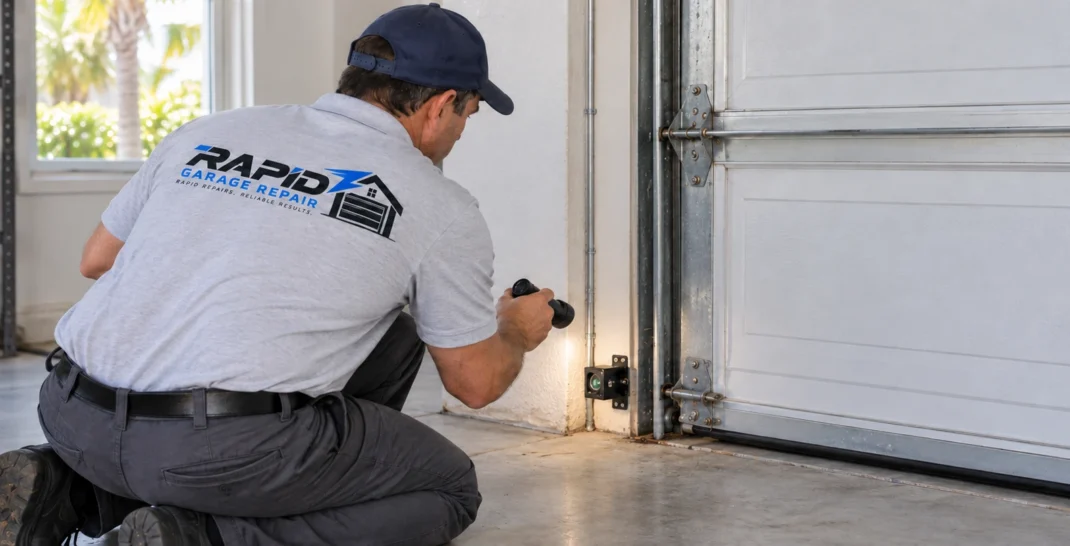
Photoelectric safety sensors are usually positioned low on opposite sides of the opening. They communicate across the doorway using an invisible beam. An interrupted beam can prevent closing or cause a closing door to reverse.
Look for storage bins, a broom handle, a garden hose, leaves or other objects in that path. Check the space near each lens as well as the middle of the opening. Something close to a sensor can be easy to overlook when the rest of the doorway looks clear.
Remove an ordinary obstruction only when it is safe to reach. Do not move a person, pet or vehicle through the opening while someone else operates the door.
2. Check Whether the Sensor Lenses Are Dirty
If the lenses are accessible from a safe position, gently wipe them with a clean, soft cloth. Follow the manufacturer’s care instructions and avoid spraying lubricant or cleaner into the sensor housing.
Cleaning is different from realigning. You should not need to loosen a bracket, disconnect a wire or dismantle the sensor to wipe its lens.
If the door appears undamaged and you have removed a simple obstruction or cleaned an accessible lens, move clear of the opening before using the normal control. Watch the door through one closing attempt. If it still fails, reverses or moves abnormally, stop rather than repeatedly cycling it or trying to override the problem.
3. Observe the Indicator Lights
Record whether each sensor light is steady, flickering or off. Also note any display message or repeated flashes at the opener.
Do not assume one light color is correct for every brand. A color used for a transmitter on one system may have a different meaning elsewhere. The opener light, wall control light and sensor light are also different indicators.
Use the manual for the exact model to interpret the pattern. A general online guide cannot make every blinking light mean the same thing.
4. Note Whether the Problem Follows a Pattern
Write down when the failure occurs and what you can observe at that moment. A short note is useful: “It refuses to close around 4 p.m., direct sun reaches the right sensor, and it works later in the evening.”
That is more informative than simply saying the opener is intermittent. You do not need to reproduce a failure repeatedly or stand in the doorway to investigate it.
Can Sunlight Stop a Garage Door From Closing?
Yes. Sunlight can interfere with the receiving sensor on some garage door opener systems. The opener can respond as though the safety beam is obstructed even when there is no object in the doorway. Chamberlain and Genie both document sunlight-related sensor problems.
Clues include trouble during a particular part of the day, direct light reaching a sensor lens and normal operation after the lighting changes. Those observations support a sunlight check; they do not prove the sensors are the only problem.
This is relevant to a garage in Boca Raton or West Palm Beach when direct light reaches the opening. You do not need to assume Florida heat has damaged the motor. The angle of light at the sensor is a more specific observation to report.
Why Waiting Until Evening Is Not a Lasting Repair
If the door closes after sunset, that does not establish that the system is reliable for the next day. It can simply mean the condition that interfered with closing is temporarily absent.
A technician can assess the sensor arrangement and the manufacturer’s supported options. Depending on the equipment, those options can include a compatible sun shield or a different sensor placement permitted by the installation instructions. Moving a receiver can also change when it encounters direct sun, so the arrangement needs thought rather than a random swap.
Avoid copying improvised covers or sensor relocation ideas from a discussion thread. An attachment must not obstruct the beam, and changing sensor position must not compromise the intended protection of the opening.
Why Does the Door Close From the Wall Button but Not the Remote?
Be precise about how the wall control works.
If an ordinary press of the wall button opens and closes the door normally, but the remote will not operate it in either direction, the remote and control settings deserve attention. Depending on the model, possible explanations include a weak battery, lock mode, programming, compatibility or signal interference. Use the specified battery and instructions for that remote rather than assuming every remote uses the same type.
If the remote opens the door but will not close it, a closing safety issue still needs to be considered. The fact that the remote sends an opening command does not prove the sensor system is working correctly.
Also tell the technician if the door behaves differently when someone keeps a wall button pressed. Some models provide a constant-pressure closing mode in certain fault conditions. That behavior is information to report, not proof that the safety fault has been repaired.
Do not make a workaround your normal way of using a malfunctioning door.
Why Does the Garage Door Close and Then Reopen?
The point at which it reverses matters.
If the door reverses before reaching the floor, note whether something enters the sensor path or whether the door hesitates at a particular position. A sensor interruption and resistance in the door system can require different repairs.
If it reaches the floor and then reverses, closing travel is one item to assess. Chamberlain also identifies a problem with the door itself among the possible causes of this behavior. It should not automatically be treated as a bad sensor.
Avoid changing force or travel settings by trial and error. These settings interact with safe operation, and the required procedures differ by opener. A suitable assessment considers the mechanical condition first and includes the manufacturer’s required safety checks after adjustments.
When Should You Stop Checking and Call a Technician?
Arrange professional garage door service when:
• The door is crooked, jammed or visibly damaged.
• A spring is broken or a lifting cable is loose or frayed.
• Closing still fails after a safely accessible obstruction is removed or lenses are cleaned.
• The problem returns at a particular time of day.
• A sensor housing, bracket or visible wire appears damaged.
• The door repeatedly reverses, strikes the floor or moves unevenly.
• Troubleshooting would require handling wiring, loosening hardware or working beneath the door.
If the garage remains open, tell the company that the opening cannot be secured. Ask about the earliest available appointment and what you should do while waiting. Do not assume that a service request automatically confirms an arrival time.
Should You Repair the Sensors or Replace the Opener?
A sensor problem does not automatically justify replacing the complete opener. The useful question is which component has failed and whether a compatible repair is available.
Ask what supports the diagnosis. Is there an obstruction, a mounting issue, sunlight interference, a damaged wire or a faulty component? What repair is proposed, and how will normal operation and safety functions be checked afterward?
Replacing a motor will not correct an incompatible or mechanically damaged door. Likewise, replacing sensors will not resolve a remote that is incompatible with the opener.
Replacement becomes a different conversation when suitable parts are unavailable, the opener cannot provide the required safe operation, or its overall condition makes repair unsuitable. Ask for the reason in terms of your actual equipment, rather than accepting “it will not close” as a complete explanation.
What Information Should You Give When Calling for Repair?
Have these details ready if you can gather them safely:
• Your city or ZIP code.
• Whether the door is fully open, partly open or closed.
• Whether it refuses to move, reverses during travel or reopens after reaching the floor.
• Whether an ordinary wall button press and the remote produce different results.
• The time of day and whether sunlight reaches a sensor.
• The sensor light behavior and any diagnostic message.
• The opener brand and model, if the label is accessible without climbing.
• Any recent impact, loud bang or visible damage.
Ask whether a visit or diagnostic charge applies. For proposed work, ask what parts and labor are included, whether additional work needs separate approval and what warranty terms apply, if any.
You do not need to climb to the motor unit, remove its cover or identify the failed part before calling.
Garage Door Closing Problems in Boca Raton and West Palm Beach
Rapid Garage Repair is a place to start for garage door and opener service in Boca Raton and West Palm Beach. Call with your location and describe the closing behavior so service availability and the next step can be discussed.
If your door is open and you cannot secure the garage, mention that at the start of the call. For a nearby community, provide your city or ZIP code to confirm coverage.
Call Now
Frequently Asked Questions
Why Does My Garage Door Open but Not Close?
Opening successfully does not confirm that the closing safety system is working. A blocked beam, dirty or misaligned sensor, wiring problem or light interference can prevent closing. Other door and opener faults are also possible. Start by describing whether the door stays open, starts down and reverses, or reaches the floor before reopening.
Can Sunlight Cause a Garage Door Sensor Problem?
Yes. Direct sunlight can interfere with the receiving sensor on some systems. A failure that follows a particular time of day is useful evidence to report. It is not a complete diagnosis, because alignment, wiring and component faults can also affect closing. The appropriate solution depends on the equipment and installation instructions.
What Does a Blinking Garage Door Sensor Mean?
Its meaning depends on the sensor system and model. A blinking indicator can relate to an obstruction, alignment or another fault, but there is no universal color or flash pattern for every opener. Identify which indicator is blinking and consult the correct manual. Do not order a replacement sensor based on the light color alone.
Does Closing After Dark Mean the Problem Has Fixed Itself?
No. It shows that the door worked under those conditions. If it repeatedly fails while direct sun reaches a sensor and works after the light changes, ask for the sensor arrangement to be assessed. Waiting for darkness leaves the daytime problem unresolved and may prevent you from securing the garage when you need to.
Why Does My Garage Door Reverse When It Touches the Floor?
Closing travel that needs adjustment is one possible cause, but the condition of the door and other opener faults must also be considered. Report that floor contact occurs before reversal. Do not increase force to make it stay down. The correct assessment and adjustment procedure depends on the opener and door system.
Can I Bypass the Sensors to Get the Door Closed?
Do not disconnect, defeat or reposition the sensors to avoid their protective function. If closing only works through a special control mode or workaround, the underlying fault still needs attention. Follow the safety guidance for your exact model and ask a trained door systems technician how to handle an opening you cannot secure.
Do I Need a New Opener if the Sensors Are Faulty?
Not automatically. A compatible component repair may be appropriate if the fault is isolated and the rest of the system is suitable for continued use. Ask which part failed, how that was established and whether a compatible replacement exists. A complete opener replacement should have an equipment-specific reason, not simply the symptom that the door will not close.
How Much Does Fixing a Garage Door That Will Not Close Cost?
The symptom alone is not enough to price the repair. Removing an obstruction, addressing sensor wiring, replacing a compatible component and repairing mechanical damage involve different work. Ask about diagnostic charges and request an explanation of the proposed parts and labor. Photos and model details can help the initial conversation, but an inspection may be needed to confirm the scope.